
.gif)
European Journal of Case Reports and Clinical Images
European Journal of Case Reports and Clinical Images
Clinical Image | Open Access
Volume 2026 - 2 | Article ID 303 | http://dx.doi.org/10.51521/EJCRCI.2026.e22.117
Academic Editor: Dr. Jerry P
1Resident in Internal Medicine Training, Department of Internal Medicine,
Unidade Local de Saúde do Oeste – Hospital Caldas da Rainha, Caldas da Rainha,
Portugal; ORCID: https://orcid.org/0000-0001-9503-7049.
2Resident in Internal Medicine Training, Department of Internal
Medicine, Unidade local de Saúde do Alto Alentejo – Hospital de Portalegre,
Portalegre, Portugal, ORCID: https://orcid.org/0000-0002-1994-7849.
3Senior Consultant in Internal Medicine, Casa Santa Maria
(RNCCI/ERPI), Lisboa, Portugal; ORCID: https://orcid.org/0000-0003-4448-4169.
Corresponding
Author: Sara Lourenço Tereso,
ORCID: https://orcid.org/0000- 0001-9503-7049, Rua Diário de Notícias,
2500-176, Caldas da Rainha, Portugal.
Citation: Sara Tereso, Elisabete Mendes, Carlos Machado e Costa
(2026). Acquired Hypofibrinogenemia as a Paraneoplastic Manifestation of
Metastatic Prostate Adenocarcinoma. Euro J Case Rep Clin Imag. 2026; August,
e22,1-3.
Copyrights: © Sara Lourenço Tereso, 2026, et al., This article is
licensed under the Creative Commons Attribution-Non
Commercial-4.0-International-License-(CCBY-NC)
(https://europeanjournalofcasereports.com/blogpage/copyright-policy). Usage and
distribution for commercial purposes require written permission.
Image Case Presentation:
A 73-year-old man presented with abdominal pain
radiating to the lumbar region with a 3-day evolution, progressive weight loss
(20 kg) over the previous year, and no history of trauma or falls. On
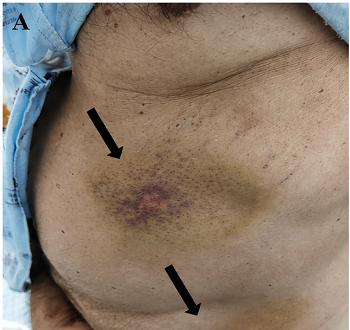
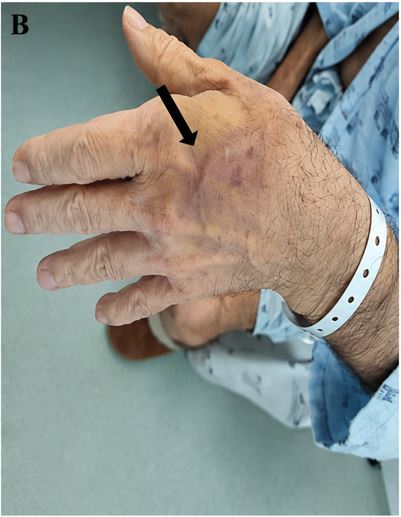
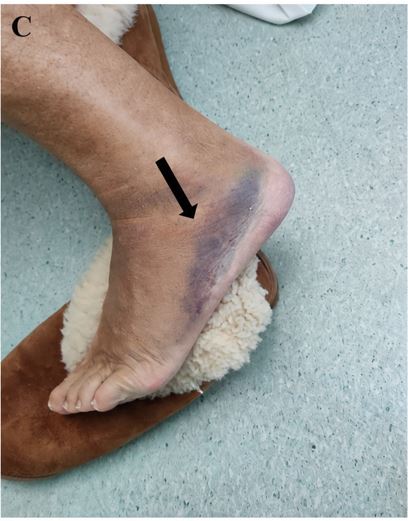
examination, he had multiple spontaneous haematomas on the abdominal wall, left
hand and right foot, at different stages of evolution (Figures 1A, 1B, &
1C). Laboratory tests showed mild bicytopenia, hypercalcaemia, normal amylase,
marked hypofibrinogenaemia (81 mg/dL), prothrombin time 17.4 s, INR 1.7, D
dimer 34.18 µg/dL, Factor X 36%, and Prostate Specific Antigen (PSA) 3640
µg/dL. Thoraco abdominopelvic computed tomography revealed diffuse osteolytic
lesions suggestive of extensive metastasis and moderate prostatic enlargement
with an asymmetric left sided protruding area. Transrectal prostate biopsy
demonstrated acinar adenocarcinoma of the prostate, Gleason score 7. Based on
the clinical and histological findings, and after excluding differential
diagnoses, a diagnosis of acquired hypofibrinogenaemia as a paraneoplastic manifestation
of metastatic prostate adenocarcinoma was established. He received fibrinogen
concentrate for haemorrhagic prophylaxis and vitamin K for INR correction,
without long term normalisation. One month after starting degarelix
chemotherapy, fibrinogen levels normalised, PSA decreased and the haematomas
regressed. Acquired hypofibrinogenaemia as a paraneoplastic manifestation is
very rare, [1] typically described in patients with advanced disease at
presentation, [2] particularly metastatic and associated with high grade
prostate tumours [2]. Unexplained and exuberant haematomas should raise
suspicion for acquired hypofibrinogenaemia, requiring early supportive
treatment and targeted anti androgen therapy [1-3].
Declarations:
Funding: This research received no external funding.
Institutional
Review Board Statement: Not
applicable.
Informed
Consent Statement: Informed consent
for publication was obtained from the patient’s legal guardians.
Data
Availability Statement: No
new data were created or analyzed in this study. Data sharing is not applicable
to this article.
Acknowledgments: Not applicable.
Conflicts
of Interest: We confirm that there
are no conflicts of interest to declare.
References:
1. Cvetkovic Z, Cvetkovic B, Celeketic D, Libek V,
Perunicic PC. Paraneoplastic bleeding disorder due to isolated
hypofibrinogenemia: A Case Report. Hippokratia. 2009 Jan-Mar, 13,1:52-54.
2. Ong SY, Taverna J,
Jokerst C, Enzler T, Hammode E, Rogowitz E. et al., Prostate Cancer-Associated
Disseminated Intravascular Coagulation with Excessive Fibrinolysis treated with
degarelix. Case reports in oncological medicine. 2015 Nov, 212543. DOI: 10.1155/2015/212543.
3. Besser MW, MacDonald
S. Acquired hypofibrinogenemia: current perspectives. J Blood Med. 2016 Set, 7:
217-225. DOI: 10.2147/JBM. S90693.


.png)








.jpg)


.png)