
.gif)
European Journal of Case Reports and Clinical Images
European Journal of Case Reports and Clinical Images
Case Report | Open Access
Volume 2026 - 2 | Article ID 310 | http://dx.doi.org/10.51521/EJCRCI.2026.e22.124
Academic Editor: John Bose
Sánchez Magallán-González Rodrigo1, Robles-Lomelín
Pilar1, Rivera-Monroy Germán2, López-Gil Salvador3
1Internal
Medicine Department, Centro Médico ABC, Mexico City.
2Internal
Medicine Department, Médica Sur, Mexico City.
3Nephrology, Centro Médico ABC, Mexico City.
Corresponding author: López-Gil Salvador, Nephrology, Centro Médico ABC, Mexico City, Sur 136 No. 116, Las Américas, Álvaro Obregón, 01120, Cd. de México, e-Mail: salvadorlgil@gmail.com.
Citation: Sánchez Magallán-González Rodrigo, Robles-Lomelín Pilar, Rivera-Monroy Germán, López-Gil Salvador (2026). Clear Cell Renal Carcinoma Pituitary Recurrence Presenting as Panhypopituitarism Manifested as Chronic Diarrhea: A Case Report and Brief Literature Review.. Euro J Case Rep Clin Imag. 2026; November, e22,1-4.
Copyrights: © López-Gil Salvador, 2026, et al., This article is licensed under the
Creative Commons Attribution-Non Commercial-4.0-International-License-(CCBY-NC)
(https://europeanjournalofcasereports.com/blogpage/copyright-policy). Usage and
distribution for commercial purposes require written permission.
ABSTRACT
Background. Clear cell renal carcinoma is the
most common histologic subtype of renal cell carcinoma and has the worst
overall survival. Metastatic disease may develop in 20 to 40% of patients after
radical nephrectomy. Pituitary metastasis is a rare presentation.
Objective. To report a case of pituitary
metastatic recurrence of clear cell renal carcinoma that presented as
panhypopituitarism, with chronic diarrhea as the main manifestation.
Case description. A 70-year-old man with type 2
diabetes mellitus, hypertension, multifactorial chronic kidney disease, and a
right radical nephrectomy one year earlier for clear cell renal carcinoma, with
no evidence of recurrence on follow-up, presented to the emergency room with
general malaise and chronic watery diarrhea, weight loss, fatigue, and
diplopia. He had bitemporal hemianopsia, right third and sixth cranial nerve
palsies, and a right pupil unresponsive to light, consistent with cavernous
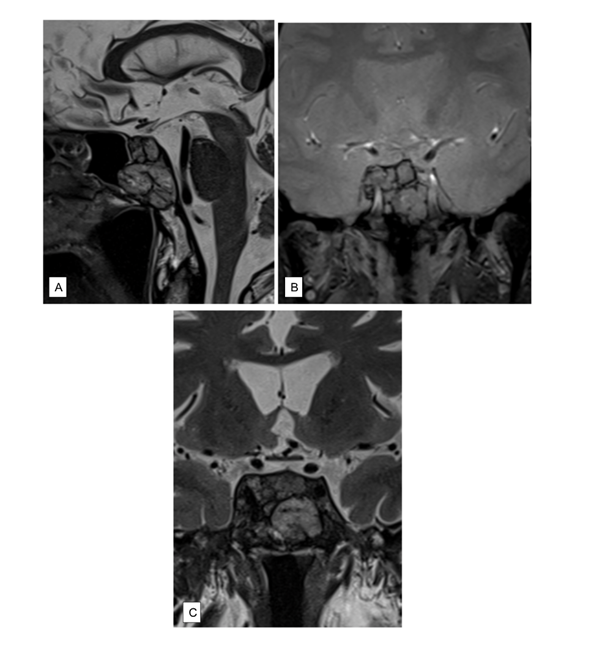
sinus syndrome and partial Horner syndrome. Magnetic resonance imaging showed
an extra-axial mass infiltrating the hypophyseal fossa. Panhypopituitarism was
documented (decreased morning cortisol, central hypothyroidism,
hypogonadotropic hypogonadism, and elevated prolactin); with stress-dose
hydrocortisone and levothyroxine, symptoms and blood pressure improved. A
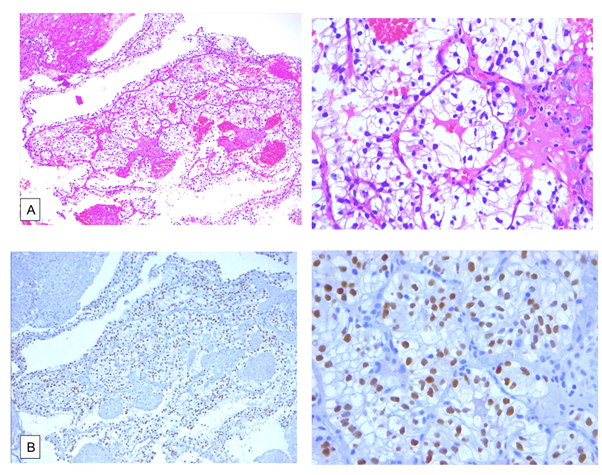
transnasal biopsy confirmed metastatic recurrence of clear cell renal
carcinoma. Nivolumab and directed gamma knife radiotherapy were offered.
Conclusions. Pituitary metastases are rare. We
report an unusual presentation: chronic diarrhea as the main sign of
panhypopituitarism secondary to pituitary recurrence of clear cell renal
carcinoma.
Keywords. Carcinoma, Renal Cell; Panhypopituitarism; Pituitary Neoplasms; Diarrhea; Neoplasm Metastasis.


.png)







.jpg)


.png)