
.gif)
European Journal of Case Reports and Clinical Images
European Journal of Case Reports and Clinical Images
Case Series | Open Access
Volume 2026 - 2 | Article ID 297 | http://dx.doi.org/10.51521/EJCRCI.2026.e21.111
Academic Editor: John Bose
Corresponding
Author:
Dr. Fadi Alhussein, Shinas Health center, Oman, Email: mailto:wwwfady2000@gmail.com
Citation: Health center,
Oman (2026). Silver Nitrate Chemical Matrix Cauterization After Partial Lateral
Nail Avulsion: A Case Series. Euro J Case Rep Clin Imag. 2026; February,
e21,1-4.
Copyrights � Dr. Fadi
Alhussein, 2026, et al., This article is licensed under the Creative Commons
Attribution-Non Commercial-4.0-International-License-(CCBY-NC) (https://worldjournalofcasereports.org/blogpage/copyright-policy).
Usage and distribution for commercial purposes require written permission.
Abstract
Background:
Ingrown toenail [onychocryptosis] is a common
condition encountered in primary care and minor surgical practice and most
frequently affects the great toe [1,6]. Several surgical and chemical
matricectomy techniques have been described to reduce recurrence, particularly
in moderate to severe or recurrent cases [1,3]. This study presents a case series
evaluating a modified technique using silver nitrate chemical matrix
cauterization following partial lateral nail avulsion.
Methods:
This descriptive case series included patients
with clinically diagnosed ingrown toenail treated at Shinas Health Complex. The
standardized procedure consisted of partial lateral nail avulsion followed by
chemical cauterization of the nail matrix using silver nitrate. Patients were
followed to assess healing time, complications, and recurrence. Informed
consent was obtained from all patients prior to the procedure.
Results:
Complete wound healing was achieved within two
weeks in all patients. One patient with diabetes mellitus developed a localized
postoperative infection, which resolved completely within 10 days with conservative
management. Deposition of silver nitrate material beneath the nail plate was
observed in one case without long-term complications. The overall success rate [non-recurrence]
was approximately 95%.
Conclusion:
Silver nitrate chemical matrix cauterization after
partial lateral nail avulsion appears to be a safe, effective, and practical
technique for the management of ingrown toenail, with favorable healing time
and a low recurrence rate.
Introduction
Ingrown toenail is a frequent nail disorder caused
by penetration of the lateral edge of the nail plate into the periungual soft
tissue, leading to pain, inflammation, and possible infection [5]. It is one of
the most common nail conditions encountered in family medicine and surgical
clinics [1].
Conservative management is effective in mild
cases; however, moderate to severe or recurrent ingrown toenails usually
require surgical intervention [1,3]. Partial lateral nail avulsion combined
with chemical matricectomy has been shown to significantly reduce recurrence
when compared with nail avulsion alone [1,4]. Phenol is the most commonly used
chemical agent; however, alternative agents such as silver nitrate have been
explored as effective options with potentially favorable safety profiles [2].
Methods
This study is a descriptive case series conducted
at Shinas Health Center, Oman. Patients with clinically diagnosed ingrown
toenail were treated using a standardized protocol.
After partial lateral nail avulsion, the exposed
nail matrix was chemically cauterized using silver nitrate. Petroleum jelly was
applied to the surrounding skin to protect adjacent tissues. Silver nitrate was
applied for 30�60 seconds, followed by irrigation with normal saline to
terminate the chemical reaction. Standard post-procedure wound care
instructions were provided to all patients.
Informed consent was obtained from all patients
prior to the procedure. Patient data were anonymized for analysis.
Results
All treated patients achieved complete
epithelialization within two weeks. A localized postoperative infection
occurred in one patient with diabetes mellitus; the infection was mild, limited
to the surgical site, and resolved completely within 10 days with local care.
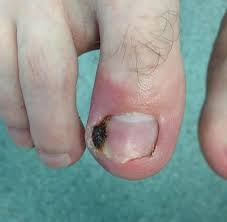
In one case, deposition of silver nitrate material
beneath the nail plate was observed. This did not result in persistent symptoms
or long-term complications. No severe complications were recorded. The
recurrence rate was low, with an overall success [non-recurrence] rate of
approximately 95%.
Discussion
Previous studies have demonstrated that chemical
matricectomy following partial nail avulsion is associated with lower
recurrence rates than surgical treatment alone [1,3,4]. Phenol matricectomy has
been extensively studied; however, it may be associated with prolonged drainage
and delayed healing in some patients [1].
Recent studies have suggested that silver nitrate
may be an effective alternative chemical agent for matricectomy, with
satisfactory outcomes and acceptable safety [2]. The findings of this case
series support these observations, demonstrating rapid healing, minimal
complications, and a low recurrence rate.
The occurrence of a localized infection in a
diabetic patient emphasizes the importance of careful postoperative monitoring
in high-risk populations. Based on our experience, partial lateral nail
avulsion appears to be a particularly safe approach in such patient.
Discussion
Previous studies have demonstrated that chemical
matricectomy following partial nail avulsion is associated with lower
recurrence rates than surgical treatment alone [1,3,4]. Phenol matricectomy has
been extensively studied; however, it may be associated with prolonged drainage
and delayed healing in some patients [1].
Our technique is based on and consistent with the
findings reported in a Spanish study by Delgado-Miguel et al., which
demonstrated the safety and efficacy of silver nitrate chemical matricectomy
following partial nail avulsion [2].
The findings of the present case series support
these observations, demonstrating rapid healing, minimal complications, and a
low recurrence rate.
The occurrence of a localized infection in a
diabetic patient emphasizes the importance of careful postoperative monitoring
in high-risk populations. Based on our experience, partial lateral nail
avulsion appears to be a particularly safe approach in such patients.
Funding: This research received no external
funding.
Institutional Review Board Statement: Not applicable.
Informed Consent Statement: Not applicable.
Data Availability Statement: No new data were created or analyzed
in this study. Data sharing is not applicable to this article.
Acknowledgments: Not applicable.
Conflicts of Interest: The authors declare no conflict of
interest.
References
[1]. Mayeaux EJ Jr, Carter C, Murphy TE. Ingrown
toenail management. Am Fam Physician. 2019;100[3]:158�164.
[2]. Delgado-Miguel C, R�os-Buceta L, et al.
Chemical matricectomy with silver nitrate after partial nail avulsion for the
treatment of ingrown toenails. Actas Dermo-Sifiliogr�ficas.
2022;113[9]:856�861.
[3]. Eekhof JAH, Van Wijk B, Knuistingh Neven A,
Van der Wouden JC. Interventions for ingrowing toenails. Cochrane Database Syst
Rev. 2012;[4]:CD001541.
[4]. Bos AMC, van Tilburg MW, van Sorge AA,
Klinkenbijl JHG. Randomized clinical trial of surgical technique and local
antibiotics for ingrowing toenail. Br J Surg. 2007;94[3]:292�296.
[5]. Heifetz CJ. Ingrown toenail: a clinical
study. Am J Surg. 1937;38:298�315.
6. Zuber TJ. Ingrown toenail removal. Am Fam
Physician. 2002;65[12]:2547�2552.


.png)








.jpg)


.png)