
.gif)
European Journal of Case Reports and Clinical Images
European Journal of Case Reports and Clinical Images
Clinical Image | Open Access
Volume 2026 - 2 | Article ID 304 | http://dx.doi.org/10.51521/EJCRCI.2026.e22.118
Academic Editor: Dr. Jerry P
1Resident in
Internal Medicine Training, Department of Internal Medicine, Unidade Local de
Saúde do Oeste – Hospital Caldas da Rainha, Caldas da Rainha, Portugal; ORCID:
https://orcid.org/0000-0001-9503-7049.
2Resident in Internal Medicine Training, Department of Internal
Medicine, Unidade local de Saúde do Alto Alentejo – Hospital de Portalegre,
Portalegre, Portugal, ORCID: https://orcid.org/0000-0002-1994-7849.
3Senior Consultant in Internal Medicine, Casa Santa Maria
(RNCCI/ERPI), Lisboa, Portugal; ORCID: https://orcid.org/0000-0003-4448-4169.
Corresponding Author: Sara Lourenço Tereso, ORCID: https://0000- 0001-9503-7049, Rua
Diário de Notícias, 2500-176, Caldas da Rainha, Portugal.
Citation: Sara Tereso, Elisabete Mendes, Carlos Machado e Costa
(2026). Takotsubo Syndrome with Transient Apical Ballooning. Euro J Case Rep
Clin Imag. 2026; August, e22,1-3.
Copyrights: © Sara Lourenço Tereso, 2026, et al., This article is
licensed under the Creative Commons Attribution-Non
Commercial-4.0-International-License-(CCBY-NC)
(https://europeanjournalofcasereports.com/blogpage/copyright-policy). Usage and
distribution for commercial purposes require written permission.
Image Case Presentation:
A
73-year-old woman with arterial hypertension presented to the hospital with
chest pain radiating to the shoulders and back, beginning the previous day,
lasting 12 hours, and recurring with minimal exertion. The pain was associated
with an episode of anxiety related to her son’s recent job loss. On physical
examination, vital signs were stable. Laboratory tests showed a troponin T of
231 ng/L. The electrocardiogram demonstrated sinus rhythm at 84 bpm, with mild
ST segment elevation in V2–V4, biphasic P waves, and T wave inversion from V2
to V6. Transthoracic echocardiography revealed apical hypokinesia. Coronary
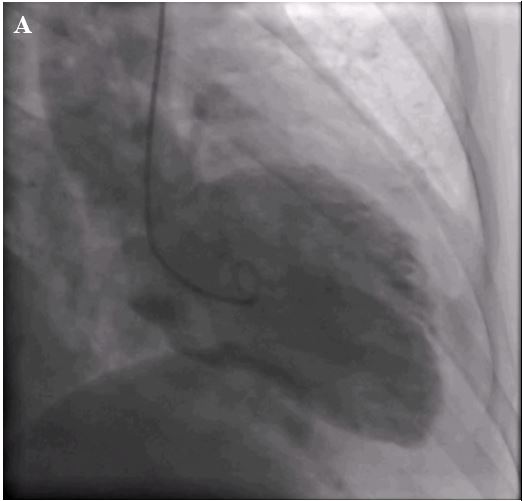
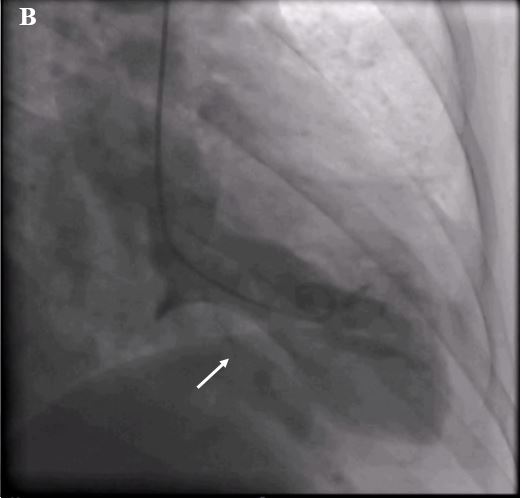
angiography excluded significant coronary lesions. Left ventriculography showed
contractility abnormalities of the left ventricle, with akinesia of the apex
and apical segments, and a left ventricular ejection fraction of 48%, findings
suggestive of Takotsubo syndrome (TS). The diagnosis was established based on
the clinical presentation and imaging features (Figures 1A, 1B). Supportive
treatment was initiated, and repeat echocardiography demonstrated recovery of
segmental wall motion in the apical segments, with preserved global systolic
function (LVEF 63%). TS is characterised by transient left ventricular
dysfunction with abnormal wall motion [1] and apical ballooning [2]. It
predominantly affects postmenopausal women and is usually triggered by
emotional or physical stress, [1-4] mimicking an acute coronary syndrome, [2,3]
which makes diagnosis challenging [1]. Coronary angiography with left
ventriculography remains the gold standard, and the condition generally carries
a favorable prognosis [1].
Declarations:
Funding: This
research received no external funding.
Institutional Review Board Statement: Not applicable.
Informed Consent Statement: Informed consent for publication was obtained from the patient’s
legal guardians.
Data Availability Statement: No new data were created or analyzed in this study. Data sharing
is not applicable to this article.
Acknowledgments: Not applicable.
Conflicts of Interest: We confirm that there are no conflicts of interest to declare.
References:
1. Ghadri JR, Wittstein IS, Prasad A, Sharkey S, Dote K, Akashi YJ, et
al. International Expert Consensus Document on Takotsubo Syndrome (Part I):
Clinical Characteristics, Diagnostic Criteria, and Pathophysiology. Eur Heart
J. 2018 June, 39(22):2032-46. DOI: 10.1093/eurheartj/ehy076.
2. Gianni M, Dentali F, Grandi AM, Sumner G, Hiralal R, Lonn E. Apical
ballooning syndrome or takotsubo cardiomyopathy: a systematic review. Eur Heart
J. 2006 July, 27:1523-9. DOI: 10.1093/eurheartj/ehl032.
3. Richard C. Stress-related cardiomyopathies. Ann Intensive Care.
2011 Set, 1:39. DOI: 10.1186/2110-5820-1-39.
4. Marcucci R, Mannini L, Andrei V, Bandinelli B, Gori AM, Fatucchi S, et
al. Hyperviscosity and endothelial dysfunction related to transient
stress in Takotsubo syndrome: a temporal course study. Heart and vessels. 2022
April, 37(10):1776-1784. DOI: 10.1007/s00380-022-02071-6.


.png)








.jpg)


.png)